
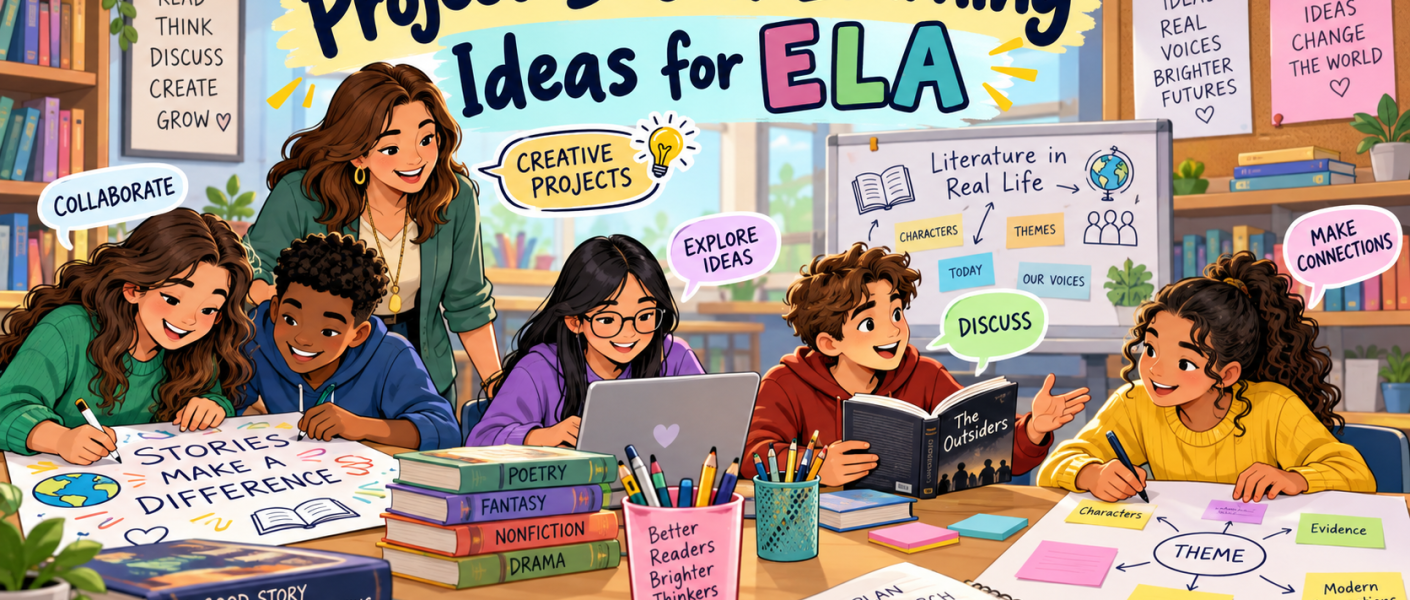
Project-based learning can completely change the way students experience English Language Arts.
Instead of completing a worksheet, answering a few comprehension questions, and moving on, students use their reading, writing, speaking, listening, and critical-thinking skills to create something meaningful.
And that is one of the best things about project-based learning in ELA: you aren’t abandoning the standards. Students are still analyzing texts, citing evidence, writing arguments, researching topics, collaborating, and presenting ideas. They’re simply doing those things as part of a larger project.
If you’re looking for ways to bring more creativity and student choice into your middle school ELA classroom, here are some project-based learning ideas you can use with novels, short stories, nonfiction, poetry, and writing units.
What Is Project-Based Learning?
Project-based learning, or PBL, gives students an extended problem, question, or challenge to investigate.
Instead of the teacher providing all of the information, students take more responsibility for their learning. They may research, read, write, collaborate, make decisions, revise their work, and eventually create a final product or presentation.
A strong ELA project usually includes several elements:
- An engaging question or challenge
- Student choice
- Reading and research
- Writing
- Collaboration
- Critical thinking
- Revision and reflection
- A final product or presentation
The project doesn’t have to take an entire month, either. Some PBL activities can be completed in several class periods, while larger projects might become the focus of an entire unit.
1. Create a Social Awareness Campaign
Give students a real-world issue and ask them to create a campaign designed to educate or persuade an audience.
Students might investigate topics such as cyberbullying, school safety, littering, animal welfare, social media use, environmental issues, or another age-appropriate concern.
After researching the issue, students could create:
- Posters
- Speeches
- Brochures
- Videos
- Infographics
- Social media-style posts
- Public service announcements
This project is especially effective during an argumentative writing or rhetoric unit.
Students must determine their audience, develop a claim, select strong evidence, and decide which persuasive techniques will make their message most effective.
Skills Practiced
Research, argumentative writing, evaluating sources, rhetoric, speaking, visual communication, and citing evidence.
2. Design a Book Marketing Campaign
After finishing a novel, ask students to imagine that they have been hired by a publishing company to promote the book.
Their goal is to convince a specific audience to read it.
Students could create a complete marketing campaign that includes a book poster, trailer, social media advertisement, tagline, character spotlight, and written book recommendation.
You can also challenge students to identify the book’s intended audience and explain why their marketing choices would appeal to that audience.
This is much more engaging than simply asking students to write another traditional book report.
Skills Practiced
Summarizing, theme, characterization, audience awareness, persuasive writing, media literacy, and presentation skills.
3. Put a Character on Trial
A mock trial is one of my favorite ways to get students digging deeply into a text.
Choose a character who has made a questionable decision and put that character on trial.
Students can take on roles such as:
- Prosecutors
- Defense attorneys
- Witnesses
- Jury members
- Reporters
Both sides must return to the text and gather evidence supporting their arguments.
For example, students might debate whether a character is responsible for another character’s downfall or whether a character’s actions were justified.
Instead of answering a question about characterization on a worksheet, students suddenly have a reason to analyze motivations, actions, conflicts, and consequences.
Skills Practiced
Text evidence, argument, characterization, inference, speaking, listening, and collaboration.
4. Create a Classroom Podcast
Podcasts give students an authentic reason to plan, write, revise, and speak clearly.
Small groups can create short podcast episodes connected to a text or unit.
Possible topics include:
Character Interview: One student acts as a character while another conducts an interview.
Literary Debate: Students debate a controversial decision made by a character.
Book Talk: Students recommend books to their classmates.
Theme Discussion: Students discuss an important theme and connect it to other texts or real-world situations.
Author Spotlight: Students research an author and create a short biographical episode.
Students can write scripts before recording, which gives you an excellent opportunity to teach organization, transitions, tone, and audience.
Skills Practiced
Writing, speaking, listening, research, summarizing, organization, and audience awareness.
5. Create a Museum Exhibit
Turn your students into museum curators.
After completing a novel, historical fiction unit, nonfiction study, or research project, ask groups to design an exhibit.
Their exhibit could contain artifacts, informational cards, quotations, maps, photographs, timelines, or illustrations.
Students might create a museum for:
- A novel
- A literary character
- An author
- A historical period connected to a text
- A theme
- A genre
Each item should include an explanation showing its importance.
At the end of the project, set up the exhibits around the classroom and allow students to participate in a gallery walk.
Skills Practiced
Research, informational writing, summarizing, text evidence, organization, and presentation.
6. Solve a Community Problem
One of the most authentic forms of project-based learning asks students to solve an actual problem.
Present students with a question such as:
How can we encourage more students to read?
How could we improve our school library?
How could we reduce bullying in our school?
How could we make new students feel more welcome?
Students research the problem, survey students or staff members, analyze information, and develop a proposal.
Their final product might include a persuasive letter, formal proposal, slideshow, infographic, or presentation to school administrators.
Suddenly, argumentative and informational writing have a real purpose.
Skills Practiced
Research, argument, informational writing, collaboration, problem-solving, and public speaking.
7. Create a Newspaper Based on a Novel
Ask students to become journalists reporting on the events of a novel.
Groups create a newspaper containing articles about major events from the story.
Possible sections might include:
- Breaking news
- Character interviews
- Editorials
- Advice columns
- Advertisements
- Obituaries
- Weather reports
- Sports or entertainment
- Political cartoons
Students must understand the story well enough to transform fictional events into believable journalism.
This project works especially well with novels that contain several major conflicts or important events.
Skills Practiced
Point of view, summarizing, characterization, informational writing, creative writing, and text evidence.
8. Create an Escape Room
Instead of having students complete an escape room you designed, let them create one.
Students can develop puzzles based on a novel, short story, vocabulary unit, poetry unit, or grammar concept.
To create effective clues, students must first understand the material themselves.
For example, students might create challenges involving:
- Figurative language
- Characterization
- Plot
- Theme
- Vocabulary
- Grammar
- Context clues
Groups can exchange escape rooms and attempt to solve one another’s challenges.
Creating the activity often requires even more thinking than completing it.
Skills Practiced
Comprehension, problem-solving, collaboration, question writing, analysis, and creativity.
9. Develop a Survival Guide for a Character
Ask students to create a guide that could help a character survive the conflicts he or she faces in a story.
For example:
How to Survive the Arena
How to Survive Middle School
How to Survive a Dystopian Society
How to Survive Being Stranded
Students must identify the character’s problems and provide advice based on evidence from the text.
The finished guide might include rules, warnings, illustrations, quotations, maps, or recommended supplies.
It is a fun way to combine literary analysis with informational and explanatory writing.
Skills Practiced
Characterization, conflict, inference, text evidence, explanatory writing, and creativity.
10. Create a Documentary
Documentary projects work particularly well with nonfiction and research units.
Students select or receive a topic and develop a short documentary explaining what they learned.
Before creating the final product, students must conduct research, evaluate sources, organize information, write a script, and determine which visuals would best support their message.
If recording videos isn’t practical in your classroom, students can create a documentary-style slideshow instead.
The focus should be on communicating accurate information clearly rather than fancy technology.
Skills Practiced
Research, source evaluation, informational writing, speaking, organization, and media literacy.
11. Host a Literary Theme Exhibition
Instead of assigning students a traditional theme essay, ask them to create an exhibition centered around one of the major themes of a text.
For example, students studying a novel dealing with courage might find quotations, scenes, images, symbols, songs, historical examples, or other texts that connect to that theme.
Students then explain how each selection develops the theme.
This project encourages students to move beyond simply identifying theme and start thinking about how themes develop across different texts and experiences.
Skills Practiced
Theme, text evidence, synthesis, analysis, writing, and presentation.
12. Create a Public Service Announcement
A PSA project works well with persuasive writing.
Students choose an issue and create a 30- to 60-second public service announcement designed to convince an audience to take action.
Before creating the PSA, students analyze real examples and identify the persuasive techniques being used.
Then they plan their own message.
Require students to identify:
- Their audience
- Their purpose
- Their claim
- Supporting evidence
- Persuasive techniques
- Call to action
Students can create a video, audio recording, poster, or digital presentation.
Skills Practiced
Argument, rhetoric, audience, purpose, research, speaking, and writing.
13. Create an Alternate Ending
Creative projects can still require serious textual analysis.
Ask students to write an alternate ending for a short story or novel.
The catch?
Their ending must remain believable based on what has already happened in the story.
Students must consider characterization, setting, conflict, point of view, and theme.
After writing the alternate ending, require students to explain why their version makes sense using evidence from the original text.
That final explanation turns a creative writing assignment into a strong analytical activity.
Skills Practiced
Narrative writing, characterization, plot, point of view, theme, inference, and text evidence.
14. Plan a Community Reading Event
Ask students:
How could we encourage other students to become readers?
Groups might plan a hypothetical or actual school reading event.
Students could develop book recommendations, promotional materials, activity stations, read-aloud selections, schedules, posters, or advertisements.
You could even have students design reading challenges for different grade levels.
This project provides an authentic reason for students to think about audience and communication.
Skills Practiced
Persuasive writing, informational writing, planning, speaking, collaboration, and audience awareness.
15. Create a Magazine
A class magazine allows students to combine almost every ELA skill into one large project.
Choose a theme for the magazine or allow students to develop their own.
The magazine might contain:
- Feature articles
- Short stories
- Poetry
- Reviews
- Interviews
- Advice columns
- Editorials
- Advertisements
- Illustrations
Students can take on different publishing roles, including writers, editors, designers, and proofreaders.
The finished magazine can be printed, turned into a digital publication, or shared with another class.
Skills Practiced
Writing, editing, grammar, research, collaboration, publishing, and audience awareness.
Keep Project-Based Learning Manageable
PBL sounds exciting until you imagine 30 students walking around the room asking questions at the same time.
The secret is structure.
Don’t simply announce, “You’re doing a project!” and hope students figure everything out.
Break the project into smaller checkpoints.
For example:
Day 1: Introduce the question and project.
Day 2: Research and gather evidence.
Day 3: Plan the product.
Day 4: Create the first draft.
Day 5: Peer review and revise.
Day 6: Complete the final product.
Day 7: Present and reflect.
Larger projects can obviously take longer, but students should always know what they are expected to accomplish during each stage.
Give Students Choice Without Giving Up Control
Student choice is one of the reasons project-based learning can be so engaging, but unlimited choice can quickly become overwhelming.
Instead, provide structured choice.
You might allow students to choose:
- Their topic
- Their partner
- Their audience
- Their final product
- Their research question
You don’t have to provide choice in every area.
For example, every student might investigate the same essential question while choosing whether to create a podcast, infographic, presentation, or video.
Students gain ownership while you maintain the structure needed to keep the project manageable.
Don’t Forget the ELA Standards
The final product may be the exciting part, but it shouldn’t become the entire point of the assignment.
A beautiful poster doesn’t necessarily demonstrate learning.
Before beginning a project, determine which skills you are actually assessing.
You might assess students on their ability to:
- Cite relevant textual evidence
- Develop a clear argument
- Conduct research
- Evaluate sources
- Analyze character development
- Determine theme
- Write informative text
- Participate in collaborative discussions
- Present information clearly
Build your rubric around those skills rather than simply grading how attractive the final product looks.
Include Reflection
Reflection is an important part of project-based learning that can easily be skipped when you’re ready to move on to the next unit.
Ask students questions such as:
What was the most challenging part of this project?
What would you change if you completed the project again?
What did your group do well?
What did you contribute to your group?
What ELA skill did you improve during this project?
These responses give you valuable information about student learning—and they help students recognize that the process matters just as much as the final product.
Project-Based Learning Doesn’t Have to Be Complicated
You don’t need elaborate supplies, expensive technology, or weeks of classroom time to incorporate project-based learning into middle school ELA.
Start small.
Turn a traditional book report into a book marketing campaign.
Replace a character worksheet with a mock trial.
Transform an argumentative essay into a community awareness campaign.
Have students create the review activity instead of simply completing one.
The best ELA projects give students a reason to read closely, write purposefully, communicate clearly, and think critically.
When students understand that their work is creating something rather than simply completing another assignment, engagement often changes.
And the best part?
They are still practicing exactly the ELA skills you need to teach.
Final Thoughts
Project-based learning can make middle school ELA feel more relevant without sacrificing academic rigor.
Students can analyze literature, conduct research, develop arguments, practice writing, collaborate with classmates, and communicate their ideas while working toward a meaningful final product.
You don’t have to redesign your entire curriculum around PBL. Choose one upcoming unit and replace one traditional assignment with a project.
You may be surprised by what your students create.
Which project would you try first in your ELA classroom?
Subscribe to our newsletter and get a free download of 25 AI prompts for teachers.


