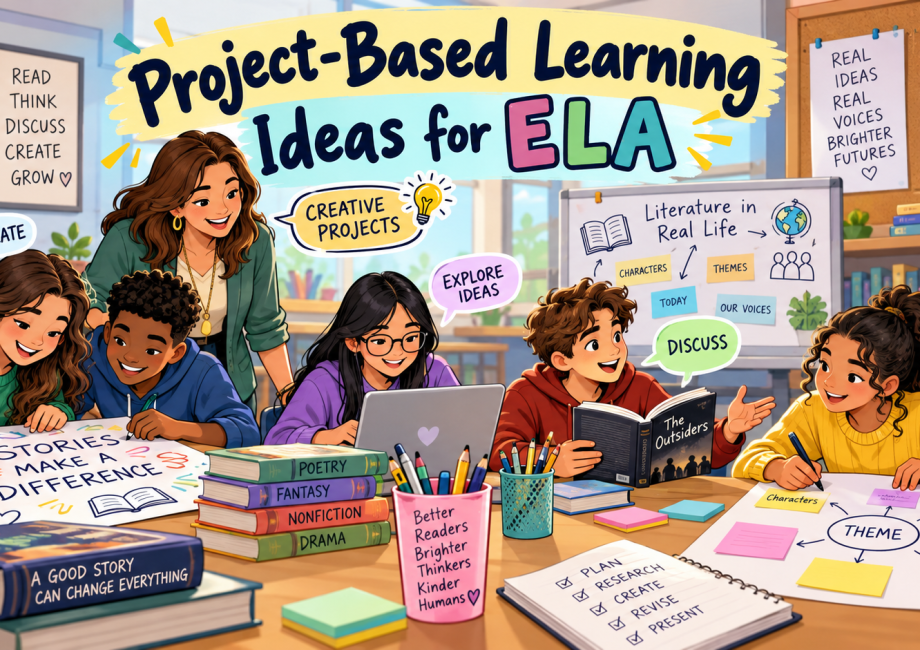
Middle school students are funny, creative, emotional, unpredictable, and full of opinions. That is exactly what makes teaching middle school ELA both rewarding and challenging. One minute, students are deeply discussing a character’s motivation, and the next minute, someone is arguing over a pencil, making sound effects, or asking to go to the bathroom for …
Teaching Informational Writing Without Boredom
Informational writing has a reputation for being dry. Students hear the words research report or expository essay and immediately imagine long paragraphs, boring facts, and a writing assignment that feels more like punishment than communication. But informational writing does not have to be boring. In fact, informational writing can be one of the most engaging …
Best Books for Reluctant Middle School Readers
Finding books for reluctant middle school readers can feel tricky. Some students say they hate reading. Some shut down as soon as they see a long chapter. Others can read but have not found a book that feels worth their time. The good news is that many reluctant readers do not actually dislike stories. They …
Teaching Vocabulary Without Worksheets
Vocabulary instruction is one of those things we know students need, but it can quickly turn into a routine of copying definitions, filling in blanks, and completing worksheet after worksheet. While worksheets can have a place, they should not be the only way students interact with new words. Students learn vocabulary best when they hear …
How to Help Students Make Inferences in Middle School ELA
Making inferences is one of those reading skills that sounds simple until students actually have to do it. We tell them, “Read between the lines,” but many students do not really know what that means. Some guess randomly. Some copy a sentence from the text and call it an inference. Others wait for the author …
5 Ways to Differentiate Reading Instruction in Middle School ELA
Differentiating reading instruction sounds wonderful in theory, but in real life, it can feel overwhelming. You have students reading above grade level, students who struggle to decode, students who can read the words but miss the meaning, students who need language support, and students who would rather do almost anything besides read. And somehow, they …
Teaching students to use text evidence effectively
Introduction One of the biggest challenges in middle school ELA is getting students to use text evidence well. Many students can find a quote from the text, but they struggle to choose the best evidence, introduce it smoothly, or explain how it supports their answer. As teachers, we often see responses like this: The character …
Teaching Tone and Mood Without Confusion
Teaching tone and mood can get tricky fast. Students often hear both words and think, “Aren’t they basically the same thing?” And honestly, it makes sense. Both tone and mood deal with feelings. Both are connected to word choice. Both can shift throughout a text. But once students understand the difference, tone and mood become …
How to Use Exit Tickets Effectively in the Classroom
Exit tickets are one of the easiest ways to check for student understanding without adding a lot of extra work to your day. When used well, they give you quick insight into what students understood, what they are still confused about, and what you may need to reteach the next day. The key is to …
Helping Students Expand Their Writing: Simple Strategies That Actually Work
One of the most common writing struggles in middle school ELA is getting students to write more. You ask for a paragraph, and you get three sentences. You ask students to explain their thinking, and they write, “This shows the character is nice.” You ask for evidence, and they drop in a quote with no …


